d0837296baef4fc14d667832c1a5215944b54a8f46af2d5c5c TipsS And TricksS: e news
Showing posts with label e news. Show all posts
on Tuesday, 17 December 2013
Facebook unveiled a “Donate Now” button today to make it much easier for non-profits to take contributions. A nice side effect for its business? The button will collect credit card numbers and other billing info for Facebook that could aid its ecommerce and gaming initiatives.
19 non-profit launch partners will start displaying the Donate Now button at the tops of their Facebook Pages and bottom of their News Feed posts. These include DonorsChoose.org (a personal favorite), Boys And Girls Club Of America, World Wildlife Fund, UNICEF, Red Cross, and Kiva. After some more testing, Facebook will open the feature to additional non-profits, who can sign up for access here.
Thanks to the Donate Now button, instead of forcing users off Facebook and away from their friends, these organizations can now accept donations in a pop-up window right on Facebook. Users can choose how much they want to give and either enter payment details or use ones already stored with Facebook. The pop-up could boost conversion rates and get more funds to needy projects.
The Donate Now button also gives people an easy way to share the call for donations with friends, helping philanthropy go viral. Facebook is not charging a fee to process credit card donations and is instead paying that fee itself so 100% of donations go to the non-profits.
Sadly, some people believe that corporations are all evil and there’s no way they could actually be staffed by decent human beings that want to help non-profits. But Facebook seems genuinely determined to help these causes, even if there’s no denying that the button could also aid its business. It’s a part of a trend of for-profit businesses launching philanthropy initiatives that could earn them money in the long run. Facebook backs Internet.org, an internet accessibility project for the developing world that could also get more people signed up for its social network. And just this morning, Comcast announced multi-million dollar backing for online education resource Khan Academy in hopes of attracting more low-income families to its reduced-price broadband service.
[Update: Perhaps Facebook should make it easier to delete your credit card info after donating. Right now you can go to your payment account settings and remove your credit cards. Adding a link there or delete button to the donate flow itself would make it easier...but would also make it tougher to donate to other non-profits in the future.]
Facebook is behind in the race to collect credit card numbers compared to app store owners like Apple and Google, and ecommerce juggernauts like Amazon. Not having payment details on file creates a barrier to people buying virtual goods in Facebook Games, or buying Facebook Gift cards for friends. The moral imperative to donate to a worthy cause could get users over the hump to keying in their credit card number or connecting another billing service like PayPal.
More payment info on file will also bolster Facebook’s latest ecommerce push: Autofill With Facebook. The system lets third-party mobile apps integrate a button in the checkout flow that lets users quickly pull in their billing and shipping info from Facebook without much typing.
Facebook doesn’t collect a fee or revenue share, but instead plans to use purchase data it peeks on through Autofill to prove the return on investment of its ads. If you click an ad to download JackThreads’ ecommerce app, use Autofill With Facebook to import your payment info that you previously entered through the Donate Now button, and make a purchase, Facebook can tell advertisers just how much money their marketing message earned them.
Again, these indirect boosts to Facebook’s business provided by Donate Now might not have been what drove Facebook to build the button, but they’re a convenient synergy. Connecting people to their friends and non-profits just so happens to make it easier to connect them to advertisers as well.


on Sunday, 15 December 2013
http://www.alexa.com/pro/subscription/configure?sid=1f6e9323-dc27-4edd-9bba-d8da10048b55#
INDIA TODAY ONLINE  NEW DELHI, NOVEMBER 25, 2013
| UPDATED 15:13 IST
Notification has been issued by the Office of Additional Deputy Commissioner-cum-Chief Executive Officer, DRDA, Palwal, to invite applications for 15 job posts. The posts on offer will be for 6 months and that too on contractual basis. Candidates interested in applying for these posts need to send in their duly filled application forms latest by December 4, 2013.


Important Dates

Last date to submit application forms: 4 December 2013

Job Post Details

Total No. of Vacancies: 15

Recruitment Type: 6 months contractual type 

Age Limit
Candidates between the age group of 21-45 years can apply for these vacancies. Relaxation in the upper age limit can be considered in case of very deserving candidates. Retired officers/ officials can also apply for these opening if they are medically fit.
 
Job Post and Eligibility Criteria

Post Name: Satistical Assistant
No of vacancies: 1
Remuneration: As per D.C. Rate 
Qualification required: M.A. in Maths/ Economics/ Statistics/ Rural Development/ MBA. Preference will be given to those having one year experience in collection, compilation and analysis of statistical data. A candidate can even apply if he/she is a graduate with Maths/ Economics/ Rural Development/ Statistics with 3 years experience in collection, compilation of statistical data. A candidate should have studied Hindi upto Matric level.

Post Name: Technical Assistant
No of vacancies: 1
Remuneration: As per D.C. Rate
Qualification required: M.A. in Maths/ Economics/ Statistics/ Rural Development/ MBA and one year experience in collection, compilation and analysis of statistical data. A candidate can even apply if he/she is a graduate with Maths/ Economics/ Rural Development/ Statistics with 3 years experience in collection, compilation of statistical data. A candidate should have studied Hindi upto Matric level.

Post Name: Jr. Scale Stenographer
No of vacancies: 1
Remuneration: As per D.C. Rate
Qualification required: Graduate or its equivalent recognized by the Govt. with a speed of 100 wpm in English and 80 wpm in Hindi. The candidate should have a shorthand speed of 20 wpm and transcription speed of 15 wpm (8% mistakes allowed). In addition, the candidate should have studied Hindi till Matric level and should posses knowledge of computers and electronic typewriter (word processors)  

Post Name: Driver
No of vacancies: 1
Remuneration: As per D.C. Rate
Qualification required: Candidate should have a minimum 5 years of experience of driving along with a valid licence. The candidate will further be examined through a trade test by an appointed authority. 

Post Name: Chowkidar
No of vacancies: 1
Remuneration: As per D.C. Rate
Qualification required: The candidate should have cleared the Matric exam from a recognized university.

Post Name: Investigator
No of vacancies: 2
Remuneration: As per D.C. Rate
Qualification required: M.A. in Maths/ Economics/ Statistics/ Rural Development/ MBA and one year experience in collection, compilation and analysis of statistical data. A candidate can even apply if he/she is a graduate with Maths/ Economics/ Rural Development/ Statistics with 3 years experience in collection, compilation of statistical data. The candidate should have studied Hindi upto Matric level.

Post Name: Accounts Clerk
No. of Vacancies: 2
Remuneration: As per D.C. Rate
Qualifications required: The candidate should have cleared B.Com from any recognized university and should possess knowledge of computers. The candidate should have studied Hindi upto Matric level.

Post Name: Accountant
No. of Vacancies: 2
Remuneration: As per D.C. Rate
Qualifications required: The candidate should have cleared B.Com from any recognized university and should possess knowledge of computers. The candidate should have studied Hindi upto Matric level.


Post Name: Peon
No. of Vacancies: 2
Remuneration: As per D.C. Rate
Qualifications required:
 The candidate should have cleared the matric exam from a recognized university.

Selection Process

Candidates will be selected on the basis of their academic record, experience and their performance during their interview session.


How to apply

Candidates can apply for the above mentioned posts by sending in attested copies of all documents to the Additional Deputy Commissioner- Cum- Chief Executive Officer DRDA, Palwal.

The recruiting authority reserves the right to postpone or cancel the interview or to reject the selection of any candidate at any time without citing any reason. 

Click here to get more information of this job post 
Click here to get the Application Form 
Click here for more job notifications
on Tuesday, 10 December 2013
By Aaron Sankin on 

As the price of Bitcoin has shot into the stratosphere, there’s been a growing chorus talking about the virtual currency not only as means of exchange but as a vehicle for investment.
Just consider the following: A single Bitcoin purchased for $65 six months ago is now worth around a $1,000, and a Malta-based Bitcoin hedge fund has posted returns of nearly 5,000 percent this year (making it the single best performing hedge fund in the world).
What is surprising, however, is that for all the chatter about Bitcoin’s investment potential, a group of major players has been notably absent from the conversation: large, established Wall Street firms.
The biggest organizations in the financial world have been conspicuously silent when it comes to Bitcoin, almost entirely staying out a staying out of a sector that’s been a huge moneymaking opportunity for those lucky enough to get in early.
We reached out to several of the largest Wall Street investment banks to inquire about their Bitcoin holdings. Most declined comment or didn’t respond. A Citigroup spokesperson said the company hasn’t made any investments in Bitcoin.
There are a number of factors why Wall Street’s institutional investors are reticent to invest in the cryptocurrency, but one oft-stated reason—volatility—likely isn’t one of them.
The price of Bitcoin is certainly skittish. During one 24-hour period last week it fluctuated in value over a range of 370 points. ‟[But] that volatility isn’t what’s scaring off major investors,” said Garrick Hileman, an economic historian at the London School of Economics, who noted that savvy operators with deep pockets often generate their largest returns when markets experience wild fluctuations.
Given the decentralized nature of the currency, when the money in them disappears, there’s not much people can do about it.
‟I write about it every day,” sighed Daniel Cawrey, editor of the Bitcoin news blog Coindesk, ‟exchanges getting hacked, people losing their money.”
Fears about a sudden inability to sell bitcoins if exchanges shut down are largely secondary to the main issue preventing companies like Goldman Sachs and Credit Suisse from jumping into the Bitcoin game: government regulation—or rather, the lack of it.
While government officials in the United States, at least at the federal level, have appeared sympathetic to Bitcoin, but there’s a lingering fear this relatively permissive attitude could change at any moment.
The lack of regulatory clarity’s also pushing banks away from doing business with companies who deal in Bitcoin.
Silicon Valley Bank, which announced a partnership with the Bitcoin business incubator Coinlab early this year, has since put the brakes on working with Bitcoin firms. ‟Until regulatory guidance is clear on banking and payment processing for virtual currency companies, we are not adding more relationships in this sector to our client portfolio,” wrote a Silicon Valley Bank spokesperson to the Daily Dot.
Bitcoin’s market cap—that is, the combined value of every Bitcoin currently in existence—is only about $12 billion. In terms of Wall Street’s biggest banks, that’s pocket change. It’s about the same dollar figure added to Apple’s market cap following a single tweet by famed activist investor Carl Icahn. It’s not really enough to justify navigating the still choppy waters of emerging Bitcoin regulation and risk the reputational risk of getting slammed by the Securities and Exchange Commission for doing deals in it that would otherwise be completely unremarkable.
“If you’re a professional investor or an financial institution, it can be difficult to invest in Bitcoin,” explained David Kintisky, general manager of the Bitcoin Investment Trust. ‟There’s no stock symbol, so you first you have to figure out how to buy it, then you have to figure out how to hold it, and explain it to your compliance guys how it all works, and then find a way to report it on your taxes.”
‟The lack of major players allows for smaller startups, like Coinbase and Bitpay, to come in and be instantly competitive,” said Cawrey. ‟If Citibank or Bank of America was handling Bitcoin transactions, these companies wouldn’t exist because banks could do it themselves with the benefit of their massive infrastructure.”
Kintisky’s Bitcoin Investment Trust is operated by the New York-based Second Market, which is primarily known for trading in pre-IPO shares of companies and functions by simply buying a whole heap of bitcoins and riding the price up and down. The fund currently holds about $70 million in assets, and Kintisky asserts that it’s the de facto player in the U.S. Bitcoin investment market.
Kintisky notes that the main investors in his fund are Silicon Valley/Silicon Alley tech entrepreneurs attracted to the novel technological aspect of Bitcoin, folks from family offices or wealth management firms (read: really rich people), and Wall Street employees making investments on their own behalf.
It’s this third category that’s most interesting because it demonstrates that, while Bitcoin may still be too risky for Wall Street firms themselves, the opportunity isn’t lost on people who follow markets for a living. “We see that there are people who work at these big firms that are very interested in Bitcoin,” Kintisky confirmed.
This interest in Bitcoin runs the spectrum from junior traders all the way up to some of the most powerful people on the industry. In October, Michael Novogratz, chief investment officer of the $58 billion Fortress Investment Group hedge fund, praised the virtual currency, saying that he has ‟a nice little Bitcoin position.”
Novogratz added that, while Fortress had looked into investing in Bitcoin in an official capacity, the firm stopped short of actually adding Bitcoin to its portfolio.
The Wedbush report argues that Bitcoin has the potential to be worth up to 100 times its current value, comparing it to a ‟biotech [company] that had a molecule that may cure the common cold.”
Bank of America, on the other hand, was more cautious, writing that the recent drastic increase in prices put Bitcoin ‟at risk of running ahead of its fundamentals,” which is a polite way of saying “bubble.”
However, both reports insisted that, contrary to the charges of critics like former Federal Reserve Chairman Alan Greenspan, Bitcoin’s ‟intrinsic value” comes as a result of its usefulness as a medium of exchange—an alternative to electronic payment formats like Visa, Mastercard, or eBay.
Gil Luria, the author of the Wedbush report, explained that once institutional investors understand the source of Bitcoin’s intrinsic value they’ll likely feel more comfortable using it as an investment vehicle. Confusion and trepidation of regulation is hindering Bitcoin investment right now, but ‟the regulatory path for how Bitcoin moves out of the grey and black markets and into a regulatory environment where institutional investors feel comfortable is pretty clear,” he said.
In the days since he published his report on Bitcoin, Luria has been flooded with calls from institutional investors interested in learning more about what it would take for their firms to begin investing in Bitcoin.
“The reaction I’ve gotten to the report has been tremendous,” he said. “It’s all I’ve been talking about all week.
“To see all of this excitement coming from so many different areas, from so many different people, leads me to believe that this is something real, that this isn’t tulips.”
Illustration by Jason Reed

on Monday, 9 December 2013

The FBI has developed advanced surveillance techniques that give it the power to covertly activate Web cams to spy on unsuspecting computer owners.
Tech savvy G-men can remotely turn on cameras that transmit real-time images to investigators — without triggering the light that shows the camera is in use, according to The Washington Post.
The FBI can also burrow into a suspect’s computer and download files, photographs and stored e-mails.
The new snooping capabilities came to light during an investigation of a mysterious man named “Mo’’ – who threatened to blow up a building filled with innocent people unless authorities free Colorado movie-theater shooting suspect James Holmes.
He also threatened to bomb a jail, a hotel, three colleges and two airports.
No bombs were found at the targets he mentioned.
He first contacted federal authorities in July 2012. It’s not clear how long Mo and the FBI were in touch.
The paper said he sometimes used an untraceable e-mail, other times an encrypted phone.
Mo even sent the FBI pictures of himself fashionably decked out in an Iranian military uniform.
The FBI, frustrated in its attempts to track him down, used special software that would install itself in Mo’s computer when he opened his e-mail.
It was designed specifically to help agents track his location and his movements.
But the software never worked as designed, the paper said, and Mo remains at large.
The feds had gotten permission to install the software from a Denver judge.
The agency tried to use it on at least one other probe, but a Houston judge described the method as “extremely intrusive’’ and probably unconstitutional — and shot it down.
The FBI has had the capability to sneak into computers’ Web cams for several years, a former employee of the agency told the Washington Post.
It was not clear how many times it tried to do it, but the paper’s source said the FBI has used its tool mainly in terrorism and the “most serious’’ investigations.
The technology is highly controversial.
“We have transitioned into a world where law enforcement is hacking into people’s computers and we have never had public debate,” Christopher Soghoian of the American Civil Liberties Union complained to the paper.


on Sunday, 8 December 2013

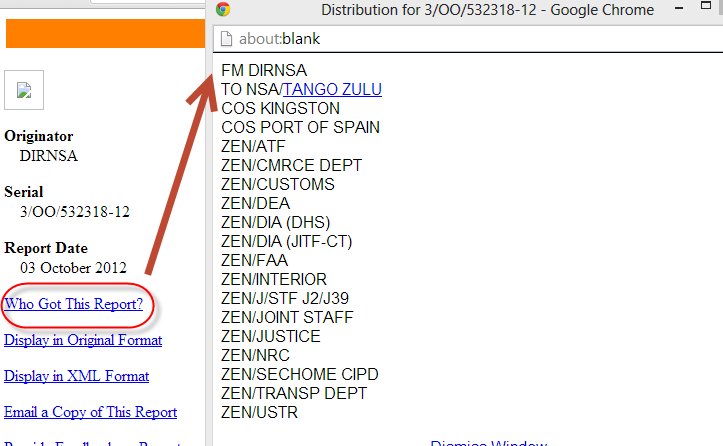
Sitting on the wire, the NSA has the ability to track and make a record of every website you visit.  Today, the Huffington Post revealed that the NSA is using this incredible power to track who visits online porn websites, and to use this information to discredit those it deems dangerous. Their porn habits would then be "exploited to undermine a target's credibility, reputation and authority."   
The story was illustrated with six individuals, none of whom are designated terrorists themselves. Instead, they are deemed "radicalizers," people—two of which the NSA itself characterized as a "well-known media celebrity" and a "respected academic"—whose speeches and postings allegedly incite hatred or promote offensive jihad. 
The report raises the specter of abusing online viewing records to discredit other political opponents of the US government. The NSA document was reviewed not just by the NSA and counter-terrorism officials, but by entities like the Department of Commerce and the US Trade Representative. The USTR negotiates treaties (like the controversial Trans-Pacific Partnership), and one could certainly imagine that the leverage from this program could be useful in pushing for the US position. In fact, EFF and three dozen civil society groups have already asked the NSA to explain if they are spying on those advocating for the public interest in US trade policy.
Ed Snowden's latest revelation may leave SEC officials quaking as the NSA "has been gathering records of online sexual activity and evidence of visits to pornographic websites as part of a proposed plan to harm the reputations of those whom the agency believes are radicalizing others through incendiary speeches." Of course, as we have seen, this 'information' would never be used by the government for non-radical-terrorist suppressing reasons, as the ACLU notes, is is "an unwelcome reminder of what it means to give an intelligence agency unfettered access to individuals' most sensitive information using tactics associated with the secret police services of authoritarian governments."
Via Snowden...
The National Security Agency has been gathering records of online sexual activity and evidence of visits to pornographic websites as part of a proposed plan to harm the reputations of those whom the agency believes are radicalizing others through incendiary speeches, according to a top-secret NSA document.

The document, provided by NSA whistleblower Edward Snowden, identifies six targets, all Muslims, as “exemplars” of how “personal vulnerabilities” can be learned through electronic surveillance, and then exploited to undermine a target’s credibility, reputation and authority.

The NSA document, dated Oct. 3, 2012, repeatedly refers to the power of charges of hypocrisy to undermine such a messenger.”
Full ACLU Statement:
The NSA considered discrediting six people by revealing surveillance evidence of their online sexual activity, visits to pornography websites, and other personal information, according to a report today in The Huffington Post. The article cited documents leaked by former NSA contactor Edward Snowden. The targets of the NSA’s plan were all Muslims whom the NSA characterized as “radicals” but who were not believed to be involved in terrorism. The documents say one of the targets was a “U.S. person,” a term describing American citizens and legal permanent residents, but all of the targets were reportedly outside the United States.

American Civil Liberties Union Deputy Legal Director Jameel Jaffer had this reaction:

“This report is an unwelcome reminder of what it means to give an intelligence agency unfettered access to individuals' most sensitive information. One ordinarily associates these kinds of tactics with the secret police services of authoritarian governments. That these tactics have been adopted by the world’s leading democracy – and the world’s most powerful intelligence agency – is truly chilling.”

The administration keeps on attempting to justify the NSA spying by claiming there is oversight from the other branches of government. But, as Pentagon Papers whistleblower Daniel Ellsberg noted in the Why Care About NSA Spying video, spying makes a mockery of that separation. How can that oversight be meaningful if the NSA's huge storehouse of information contains the private viewing habits of every senator, representative, and judge? When the only protection against abuse is internal policies, there is no serious oversight. Congress needs to take action now to rein in the spying.


on Saturday, 7 December 2013
Times of India |1 day ago |Posted By: landmarkvacanc ymanagemen
Security experts have uncovered a trove of some 2 million stolen passwords   to websites including Facebook, Google, Twitter and Yahoo from internet users across the globe. 

Researchers with Trustwave's SpiderLabs said they discovered the credentials while investigating a server in the Netherlands that cybercriminals use to control a massive network of compromised computers known as the "Pony botnet." 

The company said that it has reported its findings to the largest of more than 90,000 websites and internet service providers whose customers' credentials it had found on the server. 

The data includes more than 3,26,000 Facebook accounts, some 60,000 Google accounts, more than 59,000 Yahoo accounts and nearly 22,000 Twitter accounts, according to SpiderLabs. Victims' were from the United States, Germany, Singapore and Thailand, among other countries. 

Representatives for Facebook and Twitter said the companies have reset the passwords of affected users. A Google spokeswoman declined comment. Yahoo representatives could not be reached. 

SpiderLabs said it has contacted authorities in the Netherlands and asked them to take down thePony botnet server. 

An analysis posted on the SpiderLabs blog showed that the most-common password in the set was "123456," which was used in nearly 16,000 accounts. Other commonly used credentials included "password," "admin," "123" and "1." 

Graham Cluley, an independent security expert, said it is extremely common for people to use such simple passwords and also re-use them on multiple accounts, even though they are extremely easy to crack. 

"People are using very dumb passwords. They are totally useless," he said.

on Sunday, 1 December 2013


Paul Walker, an actor best known for his role as a fast-driving cop opposite bad-guy-gone-good Vin Diesel in the Fast and Furious movie series died on Saturday in a car crash in Santa Clarita, California, according to multiple sources. Walker was 40 years old.
News of the fatal crash spread first online after celebrity news site TMZ broke the story. Initially, most other news outlets and Twitter accounts picked it up as a report.
It was another hour before TMZ and then ABC News got confirmation from the actor's representatives.
TMZ's web site was inundated with traffic and, for a brief period of time, actually went down. When it returned, it appeared with this sentence added to the original story: "A rep for the actor confirms Paul died today in the crash after leaving a charity event."
According to the AP, Walker was a passenger in a friend's Porsche, which crashed into a light pole and tree before bursting into flames. Dramatic images of the wreckage soon spread on Twitter.

on Monday, 25 November 2013
Hacking has traditionally been a man’s world, but women are quietly breaking into the hacker subculture. Take a look at top 5 female hackers in the world.

1. Kristina Vladimirovna Svechinskaya


Kristina Svechinskaya, a New York University student is one of the most common names in the hacker’s world. She is Russian money mule maker who was arrested on November 2010 and accused of breaking into millions of dollars from several banks in Britain and America and for usage of multiple fake passports. Svechinskaya was dubbed "the world's sexiest computer hacker" for her raunchy, but casual appearance.


Svechinskaya used Zeus trojan horse to attack thousands of bank accounts along with nine others and opened at least five accounts in Bank of America and Wachovia to disburse the theft money. For all her hacking activities and for using the passports fraudulently it is said that she may have to pay huge penalty of 40 years of imprisonment. It is estimated that with nine other people Svechinskaya had skimmed $3 million in total.


2.Joanna Rutkowska

Joanna Rutkowska

Joanna Rutkowska is a Polish woman who is interested in the world of hacking security. Her name first became known as the Black Hat Briefings conference in Las Vegas, August 2006. Rutkowska presented during which the attack she had done to the security system windows vista. Not only that, Rutkowska also been attacked Trusted Execution Technology and Intel's System Management Mode. 

Early 2007 she formed Invisible Things Lab in Warsaw, Poland. A company that focuses on OS security research and consulting services as well VMM internet security. The year 2010 also Rutkowska with Rafal Wojtczuk form Qubes, an Operating System that is very full protect security. Rutkowska also open to advise Vice President of mikocok Security Technology Unit to further tighten the security system in windows vista. Waw, Rutkowska is a hacker who is very welcome to work with.


3. Ying Cracker

Ying Cracker

Cracker ying, a teacher from Shanghai China. SHe taught about the basic process of hacking guide, how to change the IP address or manipulate office password, wow!
She is also an expert in making software hackers.
In a forum titled Chinese Hackers Hottie, his name is much discussed and it makes its popularity gaining altitude. In the forum she's also got a lot of fans members. It was the beginning credibility soar.


4. Raven Alder

Raven Alder

Raven graduated from high school at the age of 14 and college at 18. She was the first woman to give a presentation at the DefCon hacker’s conference. Adler an half ISP engineer, half security geek, is a contributing author to several technical books, magazines and a frequent speaker at conferences She designs, tests and audits intrusion detection systems for large federal agencies. She has worked as a Senior Backbone Architect and Senior Security Consultant in IT security. Her interest in securing networks end-to-end has led her to examine and pioneer standards in the security of network infrastructure.


5. Xiao Tian 
 Xiao Tian
Xiao Tian, just out of her teenage became famous after forming China Girl Security Team, a group of hackers especially for woman which is China's largest today, the group has over 2,200 members. Tian created the now-infamous hacking team because she felt that there was no other outlet for teenage girls like herself in the male-dominated world of hacking. Its time to Move over male Asian nerdy computer geeks, female Asian nerdy computer geeks are here to stay.

on Friday, 15 November 2013
An Intelligence Agency is an effective instrument of a national power. Aggressive intelligence is its primary weapon to destabilize the target. Indeed, no one knows what the intelligence agencies actually do so figuring out who the best intelligence service is can be difficult. The very nature of intelligence often means that the successes will not be public knowledge for years, whereas failures or controversial operations will be taken to the press. It’s a thankless situation. Still, from what little has emerged, one can have an idea of some of the better intelligence services out there, with the understanding that this is based on incomplete data.

1) Research and Analysis Wing (RAW), India

RAW India
image credit:- www.zeenews.com

Formed                                    21 September 1968
Headquarters                          New Delhi
IndiaAgency executive           K. C. Verma
Secretary (R)Parent agency   Prime Minister’s Office, GoI

Founded in 1968, the Research and Analysis Wing (RAW), initially, focused its activities in India’s immediate neighbour hood but with the changing profile of New Delhi’s geo-political interests, it has spread its wings to other regions across the world. The agency is headquartered in New Delhi. Its chief directly reports to the Prime Minister and its operations do not come under the purview of Parliament. Often termed as an effective instrument of India’s national power, the RAW is believed to employ more than eight thousand field agents spread across the world.


2) Inter Service Intelligence (ISI), Pakistan

ISI pAKISTAN

Formed

 1948
Jurisdiction Government of Pakistan
Headquarters Islamabad, Pakistan
Agency executive Lieutenant General Ahmad Shuja Pasha, PA Director General

The Inter Service Intelligence (ISI) is said to be the top most organization with most advanced sources of information and secret agents working around the world today. Although said to be receiving the least funding as compared to other agencies stated here, but still boasts of ten thousand agents operating across the world. Although the supposedly failure in handling the Osama Bin Laden case did reduce its credit, but for a very less time until it proved its worthiness sooner with other issues prevailing in the present day It is above All laws in its host country Pakistan ‘A State, with in a State’. Its policies are made ‘outside’ of all other institutions with the exception of The Army. Its personnel have never been caught on camera. Its is believed to have the highest number of agents worldwide, close to 10,000. The most striking thing is that its one of the least funded Intelligence agency out of the top 10.

3) Military Intelligence Section 6 (MI6), United Kingdom

MI6 United kingdom

Formed

1909 as the Secret Service Bureau
JurisdictionGovernment of the United Kingdom
HeadquartersVauxhall Cross, London
Minister responsibleThe Rt Hon. William Hague MP, Foreign Secretary
Agency executiveSir John Sawers KCMG, Director General
Parent agencyForeign and Commonwealth Office
The British have had a long public perception of an effective intelligence agency (due to the success of the unrealistic, yet entertaining, James Bond movies). This perception matches reality. MI6, the British equivalent to the CIA, has had two big advantages in staying effective: The British Official Secrets Act and D notices can often prevent leaks (which have been the bane of the CIA’s existence). Some stories have emerged. In the Cold War, MI6 recruited Oleg Penkovsky, who played a key part in the favorable resolution of the Cuban Missile Crisis, and Oleg Gordievski, who operated for a decade before MI6 extracted him via Finland. The British were even aware of Norwood’s activities, but made the decision not to tip their hand. MI6 also is rumored to have sabotaged the Tu-144 supersonic airliner program by altering documents and making sure they fell into the hands of the KGB.
4) Central Intelligence Agency (CIA), USA
               CIA,USA logo

Formed

September 18, 1947
Employees20,000
Agency executiveLeon Panetta, Director
Parent agencyCentral Intelligence Group
CIA is the largest of the intelligence agencies and is responsible for gathering data from other countries that could impact U.S. policy. It is a civilian intelligence agency of the United States government responsible for providing national security intelligence to senior United States policymakers. The CIA also engages in covert activities at the request of the President of the United States of America. The CIA’s primary function is to collect information about foreign governments, corporations, and individuals, and to advise public policymakers. The agency conducts covert operations and paramilitary actions, and exerts foreign political influence through its Special Activities Division. It has failed to control terrorism activities including 9/11, Not even a single top level Al-Queda leader captured own its own in the past 9 years – ‘they missed 1 Million’ Soviet troops marching into Afghanistan’. Iraq’s Weapons of Mass Destruction, Have the found them yet? -Number of defectors/ double agents numbers close to a thousand. On 50th anniversary of CIA, President Clinton said ”By necessity, the American people will never know the full story of your courage. Indeed, no one knows that what CIA really does”. Highly funded and technologically most advanced Intelligence set-up in the world.
5) Ministry of State Security (MSS), China
MSS China
JurisdictionPeople’s Republic of China
HeadquartersBeijing
Agency executiveGeng Huichang, Minister of State Security
Parent agencyState Council 
 Known to be the most active and the largest agency operating under the Government of the People’s Republic of China the agency plays an active role in handling domestic issues as well. It is also said that the Ministry of State Security Agency works closely with other international intelligence Agencies such as ISI from Pakistan.Article 4 of the Criminal Procedure Law gives the MSS the same authority to arrest or detain people as regular police for crimes involving state security with identical supervision by the procuratorates and the courts. It is headquartered near the Ministry of Public Security of the People’s Republic of China in Beijing. According to Liu Fuzhi, Secretary-General of the Commission for Politics and Law under the Central Committee of the Communist Party of China and Minister of Public Security, the mission of the MSS is to ensure “the security of the state through effective measures against enemy agents, spies, and counter-revolutionary activities designed to sabotage or overthrow China’s socialist system.”  

6) The Institute for Intelligence and Special Operations (Mossad), Israel

Mossad Israel

FormedDecember 13, 1949 as the Central Institute for Coordination
Employees1,200 (est)
Agency executiveMeir Dagan, Director
Parent agencyOffice of the Prime Minister
The Mossad is responsible for intelligence collection and covert operations including paramilitary activities. It is one of the main entities in the Israeli Intelligence Community, along with Aman (military intelligence) and Shin Bet (internal security), but its director reports directly to the Prime Minister. The list of its successes is long. this agency has other success to its name, including the acquisition of a MiG-21 prior to the Six-Day war of 1967 and the theft of the plans for the Mirage 5 after the deal with France went sour. Mossad also assisted the United States in supporting Solidarity in Poland during the 1980s.

7) Direction Generale De La Securite Exterieure (DGSE), France
dgse
FormedApril 2, 1982
Preceding agencyExternal Documentation and Counter-Espionage Service
Minister responsibleHervé Morin, Minister of Defence
Agency executiveErard Corbin de Mangoux, Director
The Agency specializes in gathering and disseminating information related to external intelligence. The Agency operates under the directions and supervision of Ministry of Defence. The Agency also operates parallel with the Central Directorate of Interior Intelligence, whilst focusing on internal and external intelligence concerning national security.

8) Bundesnachrichtendienst (BND) – Germany
bnd germany

Formed

1 April 1956
Employees6,050
Agency executiveGehlen Organization
Parent agencyCentral Intelligence Group
The Bundesnachrichtendienst is the foreign intelligence agency of the German government, under the control of the Chancellor’s Office. The BND acts as an early warning system to alert the German government to threats to German interests from abroad. It depends heavily on wiretapping and electronic surveillance of international communications. It collects and evaluates information on a variety of areas such as international terrorism, WMD proliferation and illegal transfer of technology, organized crime, weapons and drug trafficking, money laundering, illegal migration and information warfare. As Germany’s only overseas intelligence service, the BND gathers both military and civil intelligence.
9) Federal Security Services (FSB), Russia
fsb russia
Formed3 April, 1995
Employees350,000
HeadquartersLubyanka Square
Preceding agencyKGB

Federal Security Services is the top most domestic security organization of the Russian Federation and is also known to be the successor agency of the KGB. The Agency is among the best in countering terrorism, cross border security and surveillance. Headquartered in Lubyanka Square, downtown Moscow, the agency is also believed to work with RAW (India) and other ex-soviet agencies in russia.
10) Australian Secret Intelligence Service (ASIS), Australia

asis australia

Formed13 May 1952HeadquartersCanberra, Australian Capital Territory, AustraliaAnnual budget$162.5m AUD (2007)Minister responsibleThe Hon. Stephen Smith MP, Minister for Foreign AffairsAgency executiveNick Warner, Director-General
Australian Secret Intelligence Service is the Australian government intelligence agency responsible for collecting foreign intelligence, undertaking counter-intelligence activities and cooperation with other intelligence agencies overseas. For more than twenty years, the existence of the agency was a secret even from its own government. Its primary responsibility is gathering intelligence from mainly Asian and Pacific interests using agents stationed in a wide variety of areas. Its main purpose, as with most agencies, is to protect the country’s political and economic interests while ensuring safety for the people of Australia against national threats.
hope u like this information if any mistaken have u found then pls comment and don't forget to share this information...